

Your air con stops working in the middle of January. You check the obvious stuff – it’s switched on, the remote has batteries, the circuit breaker hasn’t tripped. Everything looks fine. But nothing happens.
Nine times out of ten, the problem is either refrigerant, a failed component, or wiring. The first two need a licenced tech. Wiring problems are a bit different – some symptoms you can identify yourself, and a few basic checks are safe to carry out before you call anyone. Others absolutely aren’t and knowing the difference matters.
Here’s a practical rundown of what to look for, what it usually means, and what to do about it.
First – What Air Con Wiring Actually Does
Your air conditioning system has two main sets of wiring. There’s the high voltage power supply – the 240V circuit that runs from your switchboard to the outdoor unit. And there’s the low voltage control wiring – usually 12V to 24V – that runs between the indoor unit, the outdoor unit, and the thermostat or wall controller.
Both can develop problems. The symptoms are often different, and so is the level of risk involved in investigating them.
High voltage wiring faults are not something you poke around in. If you suspect the problem is in the main power supply – the wires running into the back of your outdoor unit, or the circuit on your switchboard – stop there and call a licenced electrician. That’s not being overly cautious, it’s just how electricity works.
Control wiring, on the other hand, carries low voltage and is generally safe to inspect visually. We’ll come back to what that involves.
Symptoms That Suggest a Wiring Problem
Not every fault is wiring-related, but these are the signs that put it on the shortlist.
The unit won’t start at all. No response from the indoor unit when you try to turn it on – no display, no fan movement, nothing. If the circuit breaker is on and power is reaching the unit, a wiring fault is a likely culprit.
It starts, then cuts out after a few minutes. This often points to a safety cutout being triggered by a wiring fault. The unit starts normally, gets partway through its startup cycle, detects something wrong, and shuts itself down as a precaution.
Intermittent operation. Works sometimes, doesn’t work other times, for no obvious reason. Intermittent faults are usually connection issues – a wire that’s partially loose or corroded making and breaking contact depending on temperature, vibration, or just luck.
Error codes on the display. Most modern split systems and ducted units will throw a fault code when something goes wrong. Check your manual or the manufacturer’s website for what your specific code means – communication errors between indoor and outdoor units often indicate a control wiring fault.
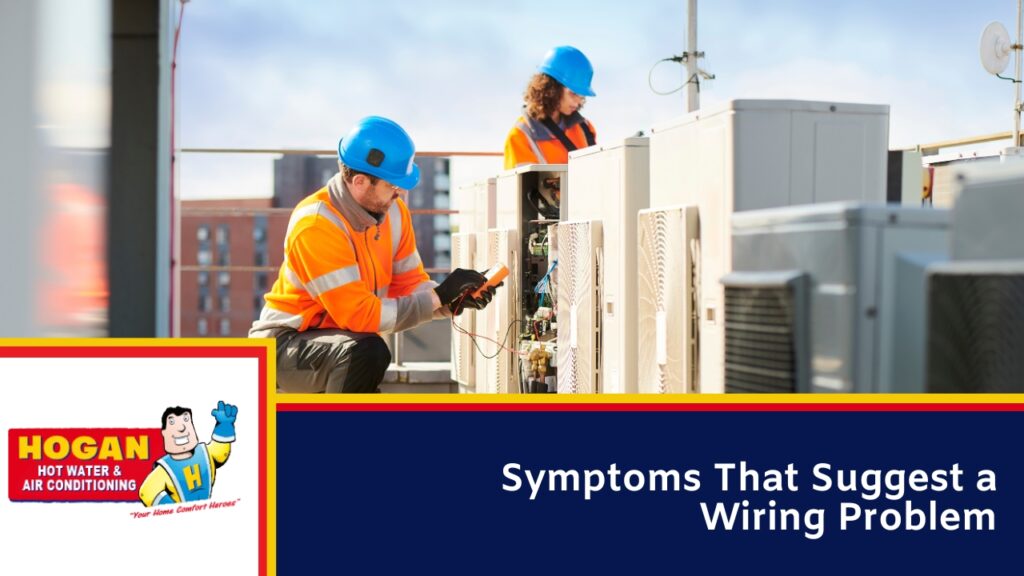
The outdoor unit runs but nothing happens inside, or vice versa. When the two units aren’t talking to each other properly, it’s usually the communication wire between them. This is the low voltage control cable that runs alongside the refrigerant lines.
Burning smell or visible scorch marks. This one’s serious. If you can smell burning plastic near your indoor unit, or you spot discolouration around terminals or on wiring, turn the unit off at the switchboard immediately. Don’t turn it back on. Call someone.
What You Can Safely Check Yourself
Before you call, there are a few things worth looking at that don’t involve opening any panels or touching any wiring.
The circuit breaker. Go to your switchboard and check whether the circuit for your air conditioning is in the on position. Sometimes they trip without being obvious about it – push it firmly off and then back on. If it trips again immediately when you turn the unit on, there’s a fault downstream and you need an electrician.
The isolator switch at the outdoor unit. Most split system outdoor units have a small isolator switch mounted nearby on the wall. It’s usually a grey or white box with a switch or pull-out fuse. Check it’s in the on position. These occasionally get switched off accidentally – during a garden tidy-up, by a sparky working on something else nearby, or just because someone was curious.
The wall controller or thermostat wiring. If your wall controller has come away from the wall slightly, or if you can see wires that look like they’ve been caught on something or pulled, that’s worth noting before you call.
Visible damage to the cable runs. Have a look at the cable running between your indoor and outdoor units – usually along an external wall or through the roof space. Rodent damage, UV degradation on old cable sheathing, physical damage from garden tools or building work – all of these can cause faults without anything inside the unit being wrong.
That’s roughly where the DIY inspection ends. Everything beyond this involves opening access panels, checking terminal blocks, and working near live components – which is licensed work in Australia.
Common Wiring Faults We See
Having done this for over twenty years across Newcastle, Lake Macquarie, and the Hunter, here’s what turns up most often.
Loose terminal connections. Vibration from the compressor gradually works connections loose over time, particularly in older units or those that run long cycles. A connection that was fine when the unit was installed five years ago may have worked its way to the point where it’s making poor contact. This causes intermittent faults and, if left long enough, arcing and heat damage.
Rodent damage to control wiring. Rats and possums are especially fond of the cable runs that pass-through roof spaces. They chew through the insulation on control wires, which causes communication errors between the indoor and outdoor units. The symptom is usually an error code on the display, or the unit starting briefly before cutting out.
Corroded connections at the outdoor unit. Outdoor units cop whatever the weather throws at them. In coastal areas – and Newcastle and the Central Coast are very much coastal – salt air accelerates corrosion on terminals. We see this a lot on systems that are more than ten years old, particularly if they haven’t had regular servicing.
Failed capacitors affecting wiring behaviour. A failed start or run capacitor can present as what looks like a wiring problem – the unit hums but won’t start, or the fan runs but the compressor doesn’t. Worth mentioning because it’s often mistaken for a wiring fault and the fix is straightforward once correctly diagnosed.
Undersized or degraded power cabling. Older homes with older wiring sometimes have air conditioning circuits that were adequate when installed but are now at the edge of their capacity – particularly if additional loads have been added to the circuit. Degraded cable insulation is also a risk in systems that have been running for fifteen or more years.
What Resolving It Actually Involves
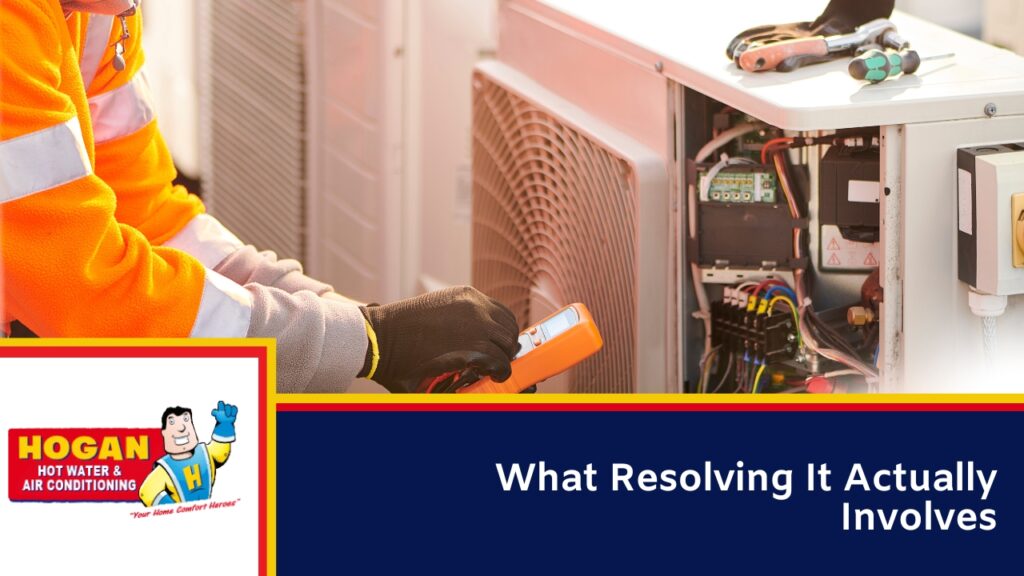
Most wiring repairs start with diagnosis – working through the system methodically with a multimeter to check for voltage, continuity, and correct resistance across components. You can’t fix what you haven’t correctly identified.
From there it depends on what’s found. A loose terminal is a straightforward fix. Rodent-damaged control wiring needs to be replaced along the full run – splicing chewed cable is a temporary repair at best. Corroded connections get cleaned back and re-terminated. Undersized power cabling needs an electrician to assess and potentially re-run the circuit.
What doesn’t get fixed by spraying WD-40 on things, waggling wires, or resetting the breaker fourteen times. We mention this because we get calls after people have spent an hour doing exactly that.
When to Call
Honestly, most air conditioning wiring problems are worth calling us about early. The DIY checks above are worthwhile – they occasionally turn up a tripped breaker or an off-isolator switch, which saves everyone time. But if those come back clear and the unit still isn’t working properly, you’re into diagnosis territory that needs the right test equipment and someone who knows what they’re looking at.
Leaving a wiring fault unresolved also tends to cause secondary damage. A loose connection that arcs will eventually burn out terminal blocks or wiring harnesses, turning a simple repair into a more expensive one.
We do air conditioning servicing, repairs, and new installations across Newcastle, Lake Macquarie, and the Central Coast. If your system is playing up and you’ve worked through the basics without finding the cause, give us a call on 0488 029 618.