

Most of the hot water systems sitting against the side of Newcastle houses right now can’t talk to a smart home, and plenty of them don’t need to. Integrating hot water systems with smart home technology comes down to three things: a system with built in WiFi connectivity such as a heat pump, a smart timer wired in by an electrician for standard electric element systems, or a signal from your network that shifts heating to the cheapest part of the day, commonly known as Controlled Load or Dedicated Supply – suitable for all electric and some heat pump systems.
Here is what each option does, what it costs to add, and where it’s worth the trouble.
What Smart Actually Means for a Hot Water System
A hot water system has one job and two settings: how hot, and when to heat. Smart control doesn’t improve the outlet temperature delivered to your taps, because the temperature is set by plumbing standards, not preference.
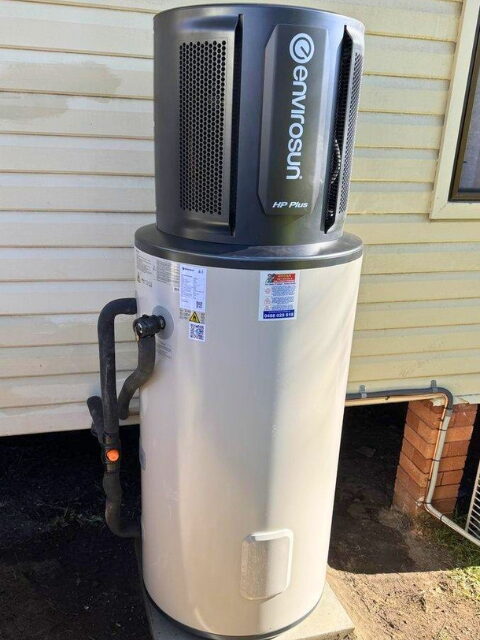
However, many heat pumps, such as the Envirosun ES330M9, do have the ability to adjust the internal temperature of the hot water system itself e.g. from 60-75 degrees Celsius. A system that can heat up to 75 degrees will provide more usable hot water than one that can only heat to 60 degrees. This is highly beneficial during the peak winter months of June, July and August where hot water usage is at its highest. Simply increasing the tank temperature via your phone app can be enough to save you running out of hot water in the middle of winter!!
The second advantage of an app is controlling when a system heats, and that’s where the savings live.
Under AS/NZS 3500.4, water in a storage tank must be stored at 60 degrees or above to keep Legionella from growing, and water delivered to bathroom fixtures has to be tempered down to a maximum of 50 degrees. So, if an app offers to drop your tank to 50 degrees to save a few dollars, ignore it. The saving don’t exist and the risk isn’t worth it. The lever that matters is timing, and the Australian Government’s YourHome guide makes the same point about hot water systems: heat pump and electric boosted solar systems can be programmed to run when your solar is producing or when tariffs are at their lowest.
For a four-person household in the Hunter, moving heating from a 4pm to 8pm peak window into the middle of the day or into overnight off-peak is worth a few hundred dollars a year. No app required to achieve it. A timer does it.
Option One: Systems With an App Built In
Most heat pump hot water systems now have built in Wi-Fi connectivity. The iStore, Apricus and Envirosun heat pumps are great examples. The systems inbuilt controller can be accessed on the unit itself or connected to an app via your home Wi-Fi allowing you to adjust the settings remotely. You can set the heating schedule, adjust the set temperature within the safe range, check whether the unit is running, and see performance over time. These units sit at a COP of roughly 4.0 to 4.8, which means around 4 to 4.8 kW of heat is produced for every 1 kW of electricity drawn.
What the app is good for, in order of how much it matters:
- Changing the heating window when your habits or the season changes, without us coming out to reprogram the controller.
- Boosting the tank before visitors arrive, then dropping it back to schedule.
- Putting the system into holiday mode from the airport instead of remembering to do it before you leave.
- Spotting that the unit has stopped running before you find out in the shower.
That last one is the sleeper. A heat pump that has faulted quietly will often go unnoticed for a day or two because the boost element keeps making hot water at three times the running cost. An app that shows you a fault code on Tuesday instead of a surprise bill in October pays for itself.
The catch is Wi-Fi. Hot water units live outdoors, frequently in a brick alcove or down the side fence, which is exactly where 2.4 GHz signal goes to die. On coastal Newcastle blocks with double brick and rendered walls, we regularly see units that pair fine during commissioning and then drop off a week later. If you want app control, budget for a mesh node or an outdoor access point near the unit. Test your Wi-Fi signal at the tank location on your phone before you decide on this feature.
Option Two: A Smart Timer for the System You Already Own
If your existing electric or heat pump system has no app and you’re not replacing it yet, a smart timer is the practical path. This is a device installed in your switchboard or next to the hot water system itself, that allows you to control when the water heater gets power via an app, based on what your solar is doing or if you have low cost for free power within your electricity plan.
An example of this is the Major Tech MTS22 Smart Programmable Timer which can be controlled via Wi-Fi or Bluetooth.
Most homes in NSW with a Smart Meter can now access FREE ELECTRICITY under the Australian Governments Solar Sharers Offer:
Solar Sharer Offer | energy.gov.au
With the help of a Smart Timer, you can program your system to heat during the Solar Sharers free power hours of 11am-2pm. Homes with an existing electric element hot water system or a heat pump can produce over 200 litres of free hot water per day during this free power window. For smaller homes, this may be all the hot water required for the day. For larger homes, additional hot water can be produced utilising any excess solar power produced in the morning or afternoon, or at night during the cheaper off peak rates of electricity if you are on a time of use plan.
Option Three: Demand Response, Which Is Already in Your Home
Most Newcastle homes with an electric storage tank are already on a controlled load tariff, where the network switches the element on overnight at a cheaper rate. That is demand response in its oldest form, and it has been quietly saving people money for decades. To check if this is part of your home power supply, look for the terms like Controlled Load, CL or Dedicated Circuit itemised on your electricity bill. If you have one of these, you are connected to the traditional off peak hot water rates, and they are surprisingly cost effective.
Power to your hot water system in this case is not programmable. The system is provided power by the network when the grid is not at peak demand. Most commonly, systems will have power available for 8-16 hours per day with the benefit of excellent rates.
You don’t install this yourself. It is provided through your retailer or network via a Controlled Load meter in your electricity box. What you should know is that it exists, it is normally the cheapest rate of electricity you can get and that it can override whatever schedule you have set on your system. It’s important that your hot water tank is sized correctly for your household to ride through a pause in power without anyone noticing.
Where Smart Home Hot Water Integration Falls Over
Four things go wrong often enough to warn you about.
Voice control is mostly a party trick. Asking a speaker to heat your water is a novelty you’ll use twice. Compare that with a smart thermostat for your air conditioning, where you adjust the setting several times a day and voice control earns its place. Hot water is set and forget by nature.
Apps don’t survive a router change. New modem, new password, and the unit drops off the network. It keeps making hot water on its last schedule, so people often don’t notice for months, then assume the system is faulty. Write your Wi-Fi credentials on a label inside the meter box.
Retrofitting isn’t always possible. Gas continuous flow systems are a good example. Rinnai Australia sells a wireless controller starter kit that puts a remote temperature controller in your bathroom or kitchen without running new cable, but that’s remote temperature control, not a smart home integration. There is no meaningful scheduling to do on a continuous flow unit, because it only fires when a tap opens.
The schedule has to match your actual bill. This is the one we fix most often. Someone sets a heat pump to run from 10am to 3pm to catch the solar, but they’re on a flat tariff with no solar and are now heating water at the most expensive time of day. The timer must be set against the tariff on your bill, not a rule of thumb from a forum.
What We Would Actually Recommend
Mike has been installing and servicing hot water systems around Newcastle for 31 years, and holds electrical, plumbing, gas fitting and refrigeration licences. Here is the order we would spend money in.
Start with the timing. On every heat pump we install, we review your electricity bill and set the heating window against your actual tariff and solar situation. It costs nothing extra, it’s the single biggest saving available, and it doesn’t depend on Wi-Fi holding up in the side yard.
Second, if you’re replacing the system anyway, choose one with an app and treat it as a monitoring tool rather than a remote control. Use it to check the unit is running and to shift the schedule when your household changes.
Lastly, if you have solar and a system worth keeping, we can price a smart timer before you price a new system.
Common Questions
Can my old electric tank be made smart?
Yes, adding a smart timer to an existing electric or heat pump hot water circuit essentially allows you to control when the system heats, making it a smart system. This can be very effective if you have a large solar power excess or have a free power window under the government Solar Shares Offer.
Will running my heat pump on a schedule shorten its life?
No. Running it in one clean cycle a day is easier on the compressor than short cycling all day. It is important to size the system correctly as limited heating times will reduce how much hot water is available if the system is too small or the heating window is not long enough. What does shorten its life is skipping 5 yearly servicing where the sacrificial anode is replaced. Anode replacement is the most crucial thing for protecting the life of you hot water system.
Do I need a smart meter for any of this?
For app control or a smart timer, no. However, the system must be connected to continuous power, not Controlled Load and the benefits would not be great. To access free power via the Solar Sharer Offer or to utilise cheaper time of use tariffs and really help with reducing your electricity costs, you must have a smart meter. If you don’t have one yet in NSW you’ll likely get one at your next meter replacement regardless.
Can you set this up for me?
The hot water side, yes. We install and configure heat pump systems, set timers against your bill, and do the electrical work when installing smart timers and relays. We don’t configure your home network.
Talk to a Licensed Technician, not a Salesperson
If you’re weighing up a new system and wondering which smart features are worth paying for, give us a call on 0488 029 618. We service Newcastle, Lake Macquarie, Maitland and the Central Coast, and we’ll tell you straight when a feature isn’t worth the money.