

Most people think about hot water costs once a year, when the bill arrives. But the real cost of a hot water system plays out over 10 to 15 years, and the cheapest system to buy is rarely the cheapest system to own.
This post breaks down the lifetime cost picture for electric and gas hot water systems in Newcastle and the Hunter, so you can decide based on the full numbers rather than just the upfront price tag.
What does ‘lifetime cost’ mean?
Lifetime cost is the total you spend on a hot water system from installation to replacement. It has three components:
- Purchase and installation cost
- Annual running costs (energy bills)
- Maintenance and repair costs over the system’s life
A system that costs $800 upfront but $1,200 a year to run is more expensive over 10 years than a system that costs $2,000 upfront but $500 a year to run. The maths matters, and most buying decisions stop at the upfront number.
Here’s the key point: purchase price is just the start. Running costs over 10 to 15 years will almost always outweigh what you paid on installation day.
Electric hot water: the cost breakdown
Electric storage systems are the cheapest to purchase and install. A standard unit with installation typically falls in the $900 to $1,800 range depending on tank size and whether any additional work is needed to bring the installation up to current standards.
Running costs are where electric storage systems take a hit. On a standard peak tariff in NSW, a family of four can expect to pay $800 to $1,200 per year to run a conventional electric storage system. That’s the highest running cost of any common system type.
The exception is off-peak tariffs. If your property has a controlled load connection, your hot water heats overnight at a significantly reduced rate, typically bringing annual running costs down to around $300 to $500 for a family of four. Not every property has this setup, but if yours does, it changes the numbers considerably.
Electric systems tend to last 10 to 12 years with reasonable maintenance, including periodic anode replacement. The brands we stock and service, including Rheem, Dux, Aquamax and Thermann, carry manufacturer warranties of 5 to 10 years.
Here’s the key point: standard electric storage is the cheapest to install but the most expensive to run. Off-peak tariffs close the gap significantly if your property supports them.
Gas hot water: the cost breakdown
Gas systems cost more upfront. A storage gas unit with installation typically runs $1,200 to $2,200, while a continuous flow system is generally $1,500 to $2,800 installed, depending on flow rate and whether any gas line work is involved.
Running costs are where gas historically wins. A 4 or 5-star storage gas system for a family of four costs roughly $380 to $500 per year to run in NSW. A 6-star continuous flow system (like the Rheem Metro 26 or Rinnai units we install) sits in a similar range, with the added benefit of no standby heat loss since the unit only fires when a tap is turned on.
Gas prices in NSW have risen 15 to 25 percent since 2022 and the trend has continued into 2026. That doesn’t change the current comparison dramatically, but it’s worth factoring into a long-term view, particularly for households deciding between a gas system and a heat pump.
Storage gas systems typically last 8 to 12 years. Continuous flow units, with fewer components under constant thermal stress, often run 15 years or more with regular servicing.
Here’s the key point: gas is cheaper to run than standard electric, typically saving $300 to $700 a year for a family of four. The higher upfront cost is usually recovered within 3 to 5 years.
Comparing the numbers over 10 years
Here’s a rough 10-year cost comparison for a family of four in Newcastle, using current 2026 figures:
| System Type | Estimated Install Cost | Estimated Annual Running Cost | Estimated 10-Year Total |
|---|---|---|---|
| Standard Electric Storage (Peak Tariff) | $1,400 | $1,000/year | ~$11,400 |
| Electric Storage (Off-Peak Tariff) | $1,400 | $400/year | ~$5,400 |
| 4-Star Storage Gas | $1,800 | $450/year | ~$6,300 |
| 6-Star Continuous Flow Gas | $2,200 | $420/year | ~$6,400 |
These are estimates, not quotes. Actual costs vary based on household usage, current energy tariffs, and the specific model installed. But the pattern is consistent: standard peak-rate electric is significantly more expensive over a decade than either gas option. Off-peak electric and gas sit much closer together.
Here’s the key point: over 10 years, a family on a standard electric tariff will likely spend $4,000 to $5,000 more than a comparable gas household. Off-peak electric and gas are much closer in total cost.
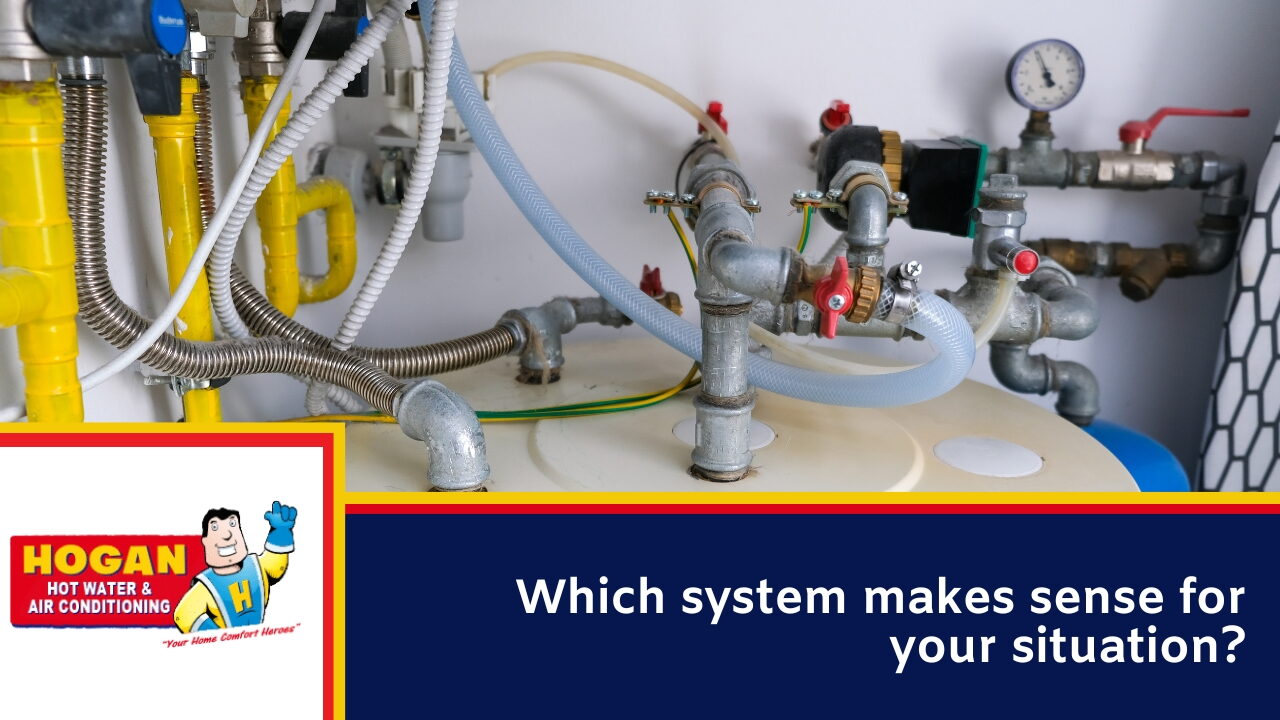
Which system makes sense for your situation?
The answer depends on a few things specific to your property.
If you have a natural gas connection already, a storage gas or continuous flow gas system is likely the most cost-effective choice in most cases. The upfront cost is moderate, running costs are lower than standard electric, and the technology is proven. Our storage gas and continuous flow gas pages cover the models and brands we recommend for different household sizes.
If you don’t have gas connected, a standard electric system with an off-peak tariff is a solid, low-cost entry point. If you have rooftop solar, running your electric hot water system during the day on solar generation can bring annual running costs down sharply.
If you’re looking at a longer-term investment, a heat pump system deserves consideration. It runs on electricity but uses far less of it than a conventional electric system, typically cutting annual energy costs by 60 to 70 percent compared to standard electric. We can talk you through the options when you call.
Here’s the key point: there’s no single right answer. The best system depends on whether you have gas connected, your current tariff, and how long you plan to stay in the property.
Frequently Asked Questions
Is gas always cheaper to run than electric?
Gas is cheaper than standard peak-rate electric in most cases. But if you’re on an off-peak or controlled load tariff, or you have rooftop solar, the gap narrows considerably. The comparison also shifts depending on which gas tariff you’re on, since supply charges add to the base cost even for low-use households.
What if I don’t have a gas connection?
Getting gas connected has its own cost, typically $1,000 to $3,000 or more depending on how far from the mains your property sits. That changes the maths on whether switching to gas makes sense. For properties without gas, an off-peak electric system or a heat pump is usually the better long-term option.
How long do these systems last?
Electric storage systems typically last 10 to 12 years. Storage gas systems run 8 to 12 years. Continuous flow gas units often exceed 15 years with regular servicing. Maintenance matters, particularly anode replacement on storage systems, which can double the effective life of the tank.
Does it matter which brand I choose?
Brand affects warranty length, parts availability, and efficiency rating. We work with Rheem, Dux, Rinnai, Aquamax, Vulcan, and Thermann, all of which have solid local support and spare parts availability in Newcastle. A 5-star gas unit will cost more upfront than a 4-star model but costs less to run annually.
Can you help me work out which system is right for my home?
Yes. Give us a call or get in touch online and we’ll ask a few questions about your property, current setup, and usage. From there we can give you a straight recommendation and a quote before any work starts.
Not sure what your home needs?
We install and service electric, storage gas and continuous flow gas hot water systems across Newcastle and Lake Macquarie. We’re not tied to one system type, so the advice you get is based on what actually makes sense for your home and budget.
Contact Hogan Hot Water and Air for a free quote or to talk through your options.