

Most people install solar hot water and then forget about it. They look at the panels on the roof, give themselves a pat on the back for saving money, and assume it will just run forever. Then winter hits. Suddenly you are in the shower, half-covered in soap, and the water turns stone cold.
Solar hot water systems are fantastic. In our local climate, they can provide 50% to 90% of your hot water for free. But they are not magic. They react to the weather. As we move from the scorching heat of a Newcastle summer into the chill of winter (and back again), you need to make a few adjustments to keep the system running efficiently and stop it from blowing up.
Heading into Winter: The Booster is Key
The biggest mistake we see is people being too afraid to use their booster switch.
In summer, the sun does all the heavy lifting. You might go 3 or 4 months without needing backup power. But in winter, the days are shorter and the sun angle is lower. The water in the tank might only reach 35°C or 40°C from the sun alone. You need to get that up to 60°C to kill bacteria (Legionella) and have a hot shower.
The Fix:
Locate your booster switch. It is usually on your switchboard or sometimes in the kitchen.
- Electric Boost – If you are on an “off-peak” tariff (like Controlled Load 1 or 2), make sure the breaker is on. The grid will top up the heat overnight.
- Gas Boost – These are usually automatic, but check the gas valve is fully open and the pilot light (if it is an older unit) is actually lit.
- Timers – If you have a timer, adjust it. In winter, set the booster to run for 2 to 3 hours in the late afternoon. This tops up whatever the sun didn’t manage to do during the day.
Watch out for Frost (Valley and Inland Residents)
If you live right on the coast in Newcastle, frost isn’t a huge drama. But if you are out towards Maitland, Cessnock, or the Hunter Valley, overnight temps often drop below 4°C. Water expands when it freezes. If the water inside your copper collector pipes freezes, it will split the pipe.
Most modern systems have “frost valves” or closed-loop glycol systems to prevent this.
- Check the valve – If you have an open-loop system, look for the frost protection valve. It looks like a small brass mushroom.
- The failure sign – If you see water trickling down the roof from the panels on a cold morning, the valve might be stuck open or doing its job. If it is gushing, you have a problem.
Heading into Summer: The Overheating Problem
Summer brings the opposite problem. Stagnation.
On a 35°C day, the temperature inside your roof collectors can hit 150°C to 200°C if you aren’t using the water. This builds up massive pressure. Your system has a Pressure Temperature Relief (PTR) valve designed to dump water if things get too hot.
This is normal safety behaviour. However, if you are going away on holiday for 2 weeks in January, your system is going to cook itself and potentially dump hundreds of litres of water.
The Fix:
- Holiday Mode – Some modern controllers have a “holiday mode” that recirculates water at night to cool the tank down.
- Cover them up – If you are going away for a month in summer, it might be worth throwing a shade cloth or a tarp over the collectors. It sounds crude, but it saves the system from unnecessary stress.
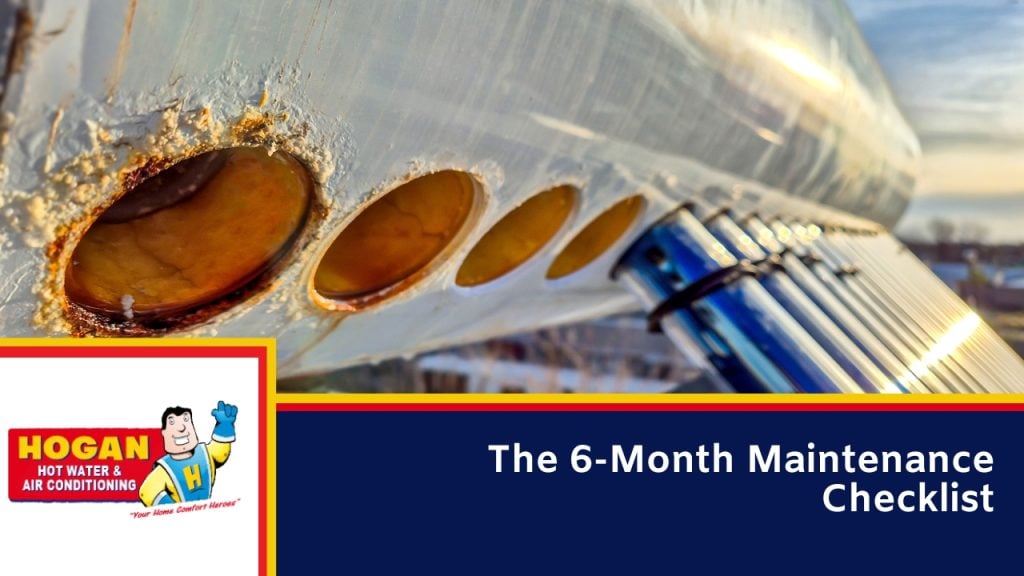
The 6-Month Maintenance Checklist
Regardless of the season, do these two things every 6 months.
1. Operate the Relief Valve
Go to the tank. You will see a little lever near the top (the PTR valve). Lift the lever gently. It should release a burst of hot water. Let it run for 5 to 10 seconds and then gently lower it back.
- Why? This clears out grit and calcium build-up. If you don’t do this, the valve can seize up. When the pressure eventually builds, the tank can split. A new valve is $150. A new tank is $2,500+. You do the maths.
2. Clean the Collectors
Dirt, dust, leaves, and bird droppings block the sun. A dirty panel can lose 10% to 20% of its efficiency.
- How? safely hose them down from the ground. If they are really bad, you might need a window cleaner or a professional to get up there. Do not climb on a wet roof yourself.
A Note on the “Sacrificial Anode”
Every tank-based system has a metal rod inside called a sacrificial anode. Its only job is to rust so the tank doesn’t. These typically last 5 years.
If your system is 6 or 7 years old and hasn’t been serviced, that anode is probably gone. Once it is gone, the tank starts rusting. Replacing the anode costs a few hundred bucks. Replacing the tank costs thousands.
Need a Hand?
If you aren’t sure if your booster is working, or you have noticed water dripping from the roof where it shouldn’t be, give us a call. We can do a quick seasonal service, check the glycol levels (for split systems), and make sure you aren’t paying for electricity you don’t need.
Call Hogan Hot Water and Air on 0488029618. We cover the whole region, and we will give it to you straight.